

October 26, 2026
Pool Goggles vs Open-Water Goggles: What’s the Difference?
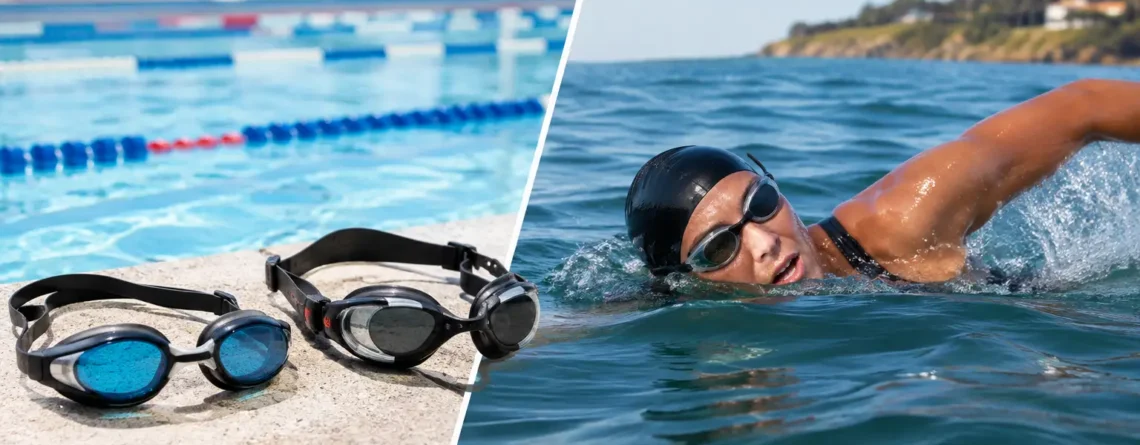
That pair of goggles that behaves perfectly during a calm lane session can feel completely different when you are sighting buoys, swimming into glare and getting slapped by a bit of chop. Pool goggles vs open-water goggles: what’s the difference? Mostly, it comes down to what you need to see, how much protection and coverage feels comfortable, and the conditions you are swimming in.
The good news is you do not automatically need two pairs. Plenty of swimmers use one reliable pair for almost everything. But if you train in the pool during the week and head to the bay, river or lake for weekend swims or triathlon practice, choosing goggles for the job can make those sessions less annoying.
Pool goggles vs open-water goggles: the practical differences
Pool goggles are generally built for predictable conditions. The water is clear enough, lane ropes keep you on track, and lighting usually stays much the same from one end of the session to the other. They are often lower-profile, closer fitting and designed to stay put through turns, kick sets and fast repeats.
Open-water goggles usually put a little more emphasis on visibility and comfort over a longer swim. They often have larger lenses or a wider field of view, plus lens tints intended to make bright conditions easier to manage. That does not mean every large goggle is for open water, or that every small goggle is only for the pool. Product labels can be a useful starting point, not a rule carved into a pool deck.
The right choice also depends on where and when you swim. A dawn ocean session off the Victorian coast can call for a very different lens from a midday lake swim in full sun. And a darkly tinted pair that feels brilliant outside may make an indoor pool look like someone forgot to turn the lights on.
Lens tint matters more outdoors
This is usually the biggest difference. In a pool, clear lenses are the simple all-round option. They let in the most light and suit indoor centres, overcast days and early sessions where you are more focused on the black line than the scenery.
For open water, sun glare is a genuine issue. Light reflects off the surface and can make it harder to spot a buoy, another swimmer or the shoreline you are using to stay on course. A smoke, mirrored or polarised lens can reduce perceived brightness and make an exposed swim more comfortable.
Polarised lenses are designed to cut glare from reflected light. They can be useful when the sun is low over flat water, which is exactly when you are trying to sight between strokes rather than admire the view. Mirrored lenses also reduce light transmission, though they are not necessarily polarised. If glare is your main frustration, check the actual lens description rather than assuming a shiny finish does the same thing.
Amber, orange or rose tints can be handy in mixed light. They may make contrast feel clearer on grey mornings, in murky water or when clouds keep rolling across the sun. They are a sensible middle ground for swimmers who do not want a clear lens but find very dark lenses too limiting.
A quick guide is useful here:
- Choose clear lenses for indoor pools, very low light and straightforward lap swimming.
- Choose light smoke, amber or rose lenses for changing conditions and early outdoor starts.
- Choose darker mirrored or polarised lenses for regular bright open-water swimming.
- Keep a second, clearer pair if you often move between outdoor sunshine and an indoor pool.
You do not need the darkest lens available just because you own a wetsuit. If you swim outside at sunrise, on cloudy mornings or in shaded water, an overly dark lens can be more hindrance than help.
Field of view helps when you need to sight
In a pool, you generally know where you are going. You can follow the line on the bottom, use the lane rope for reference and count strokes if you are practising turns. A compact goggle with a narrower view is often fine, especially if it seals well and does not move when you push off the wall.
Open water is less organised. You need to lift your eyes forward occasionally to find a buoy or landmark, while still noticing swimmers nearby. Larger lenses and a wider field of view can make this feel less cramped. For first-time triathletes, that extra awareness can be reassuring in a crowded start, when the neat order of a pool lane has disappeared rather quickly.
Still, bigger is not automatically better. A large mask-style goggle can offer a broad view but may feel bulky, catch more water if the fit is poor, or leave a bigger tan line than you planned. Try to prioritise a comfortable seal and clear forward vision over simply buying the largest lens.
Fit and seal are not pool-or-open-water issues
A goggle that leaks is annoying everywhere. In open water, it is worse because stopping to empty it can mean losing your line, swallowing a mouthful of water while treading, or getting separated from your group. The best lens tint in the world will not help if you are constantly pressing the frame back into place.
Before adjusting the strap, test the seal. Hold the goggles gently against your eye sockets without putting the strap over your head. A pair that briefly stays in place through light suction is usually a promising fit. If it falls away immediately, or pinches before you have even started swimming, try a different shape.
Many pool goggles have a smaller, more compact gasket around the eyes. Some open-water styles use a softer or broader gasket to spread pressure over a wider area. For a 30-minute squad set, you might happily tolerate a firmer fit. For a long social ocean swim, comfort becomes more important. Your face gets the deciding vote.
Avoid overtightening the strap. It rarely fixes a poor seal and often creates pressure marks and headaches. If goggles only stop leaking when the strap is pulled tight enough to leave a map of their outline on your face, the frame shape is probably wrong for you.
Low profile versus comfort for longer swims
Low-profile pool goggles sit close to the face. That can make them feel stable during tumble turns and faster-paced training, with less chance of shifting when you push off. They are a good choice for swimmers who care most about regular lap sessions and want something unfussy.
Open-water goggles may sit slightly farther from the face, particularly models with larger curved lenses. This can create more internal space and a more open feel. Some swimmers love that; others prefer the locked-in feel of a compact pair. Neither is universally better.
If you are doing a triathlon, remember that race goggles need to work before the swim as well. You may be standing around in a cap and wetsuit, dealing with nerves, wind and a crowded start. Choose a pair you can put on and adjust without a ten-minute fiddle. Save the complicated strap experiment for a quiet training day, not the start chute.
Can you use pool goggles in open water?
Absolutely, if they fit well and the lens suits the conditions. A clear or lightly tinted pair can be ideal for an overcast morning or a sheltered lake swim. Many experienced open-water swimmers favour compact goggles because they know the seal works and they do not want to change a good thing.
The limitation appears when glare is strong or you struggle to sight. If you regularly finish an outdoor swim squinting, drifting off course or stopping to work out where the buoy went, a wider lens or darker, glare-reducing tint is worth considering.
Can open-water goggles be used in the pool?
Yes, although dark lenses can be a pain indoors. Large goggles may also be less convenient for frequent tumble turns, depending on their shape and how they sit on your face. If most of your swimming is at an indoor aquatic centre, buying an open-water pair as your only goggle is often unnecessary.
A practical two-pair setup makes sense for swimmers who train several times a week in the pool and swim outdoors regularly: one clear, low-profile pair for lane work, and one comfortable pair with a suitable outdoor tint. It is not about collecting gear for the sake of it. It is about having a backup when one pair fogs, goes missing in the bottom of the swim bag, or finally gives up after plenty of chlorine and sunscreen.
Do not let anti-fog care ruin a good pair
Most goggles arrive with an anti-fog coating inside the lens. Rubbing the inside with a towel, your fingers or the corner of your shirt is a quick way to wear it down. Rinse them in fresh water after swimming, let them air-dry out of direct sun and keep them loose in a protective case or pocket rather than under wet towels and fins.
For open water, rinse off saltwater soon after your swim. For pool use, rinse away chlorine. It is a small habit, but it helps lenses stay clearer and straps last longer. Also check your goggles before race morning. Discovering a cracked lens or stretched strap at 5.45 am is a fairly ordinary sporting tragedy, but an avoidable one.
Start with the conditions you swim in most often, then choose the lens and fit that make you forget you are wearing goggles. That is about as high a compliment as swim gear gets.