

October 13, 2026
How to Use Swim Paddles Without Overdoing It
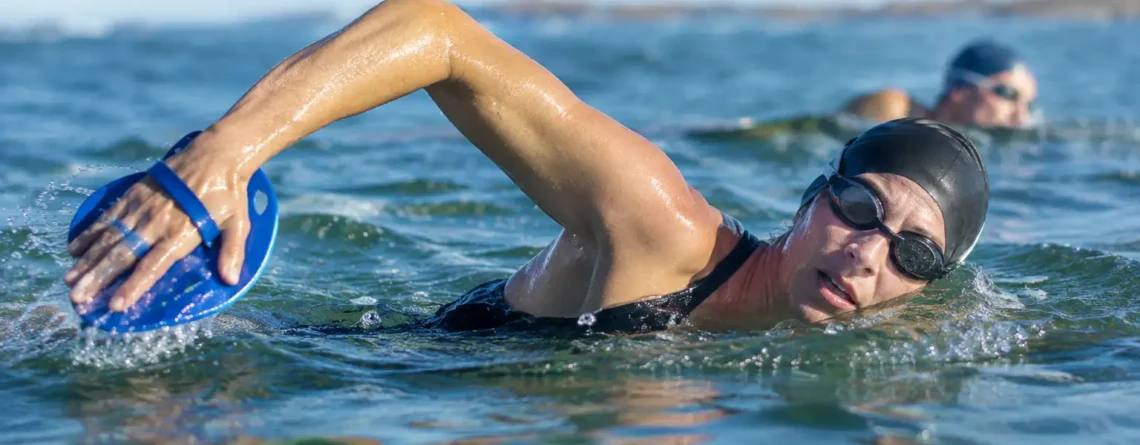
The first time you put on swim paddles, they can make you feel like you have suddenly found another gear. You grab more water, move farther each stroke and, for about 25 metres, may feel rather pleased with yourself. The catch is that paddles also magnify poor timing and tired technique. Knowing how to use swim paddles without overdoing it means getting the useful feedback and strength work without turning every pool session into a slog for your shoulders.
Paddles are not compulsory kit for every swimmer. If you are still building a comfortable freestyle stroke, a pull buoy, snorkel or a few focused drill lengths may be more useful first. But once you can swim regular laps with reasonable control, paddles can be a simple, good-value tool for improving your feel for the water.
What swim paddles actually do
A paddle increases the surface area of your hand. That means each pull meets more resistance. When your hand and forearm are in a solid position, the extra resistance helps you feel where you are catching water and encourages a firmer pull through the stroke.
When your hand slips, crosses over, or presses down instead of back, the paddle makes that obvious too. It may tug, wobble or feel as if it wants to leave without you. Annoying, yes, but useful feedback.
The trade-off is simple: more surface area also means more load with every stroke. This is why a massive paddle is not automatically a better paddle. For most recreational swimmers and triathletes, a small or medium paddle is plenty. A paddle that lets you hold good form for a short set is far more useful than a big one that turns your arms to jelly halfway down the lane.
Choose a paddle size you can control
If you are buying your first pair, resist the temptation to choose the largest option because it looks more serious. Bigger paddles suit some strong, experienced swimmers in specific sets, but they are not a shortcut to a stronger stroke.
A sensible starting point is a paddle that sits only a little beyond the edges of your hand. You should be able to enter cleanly, hold water through the pull and remove it without fighting the straps. Smaller paddles are especially sensible if you swim two or three times a week, are returning after time out, or tend to feel tight and tired through the upper body after swimming.
Finger paddles are another useful option. They cover the fingers and part of the palm rather than the whole hand, so the extra resistance is modest. They are handy for technique-focused work and for swimmers who want some feedback without a full paddle set. They will not make a hard pull set easy, which is rather the point.
Fit matters as much as size. The paddle should sit securely against your palm without being strapped on like a footy boot. Many swimmers use the finger loop only, or a light wrist strap as well, depending on the paddle design and the purpose of the set. A looser setup can give clearer feedback: if your hand enters poorly or you push sideways, the paddle shifts. Start cautiously and follow the strap arrangement recommended for your paddle.
How to use swim paddles without overdoing it
Treat paddles as a portion of your session, not the whole session. For a 1,500-metre swim, 200 to 400 metres with paddles is a sensible beginning. That might be eight 25s or four 50s with plenty of rest and easy swimming between efforts. If that feels controlled for several sessions, add a little distance rather than suddenly doing a full kilometre.
Your first paddle lengths should be smooth, not hard. Aim to keep the same relaxed body position you use when swimming well without them. Enter with your hand in line with your shoulder, extend forward without over-reaching, then begin the catch by setting your hand and forearm against the water. Think of moving your body past the hand, rather than trying to throw water behind you.
Keep your stroke rate sensible. A common mistake is spinning the arms because the paddle makes each stroke feel powerful. If your timing becomes rushed, slow down and reset. Paddles work best when they help you feel a connected catch, not when they turn the lane into an arm-wrestle with the pool.
A pull buoy can be useful with paddles, particularly for a triathlete who wants a focused upper-body set. It takes the kick out of the equation and makes it easier to concentrate on body position and the pull. But it also makes the set more demanding on the upper body, so reduce the paddle distance when combining the two. Paddles, pull buoy and a hard interval set all at once is a lot for newer swimmers.
A simple first paddle set
After an easy warm-up, try 8 x 25 metres freestyle with paddles at a controlled effort. Rest for 15 to 20 seconds after each 25. Swim 25 metres easy without paddles after every second repeat if you need to reset your technique.
For your next session, you could use 4 x 50 metres with paddles, resting 20 to 30 seconds. Stop the set if the paddle starts slapping the water, your elbows drop, or you feel yourself muscling through the pull. Finishing two repeats early is smarter than spending the next few days wishing you had not.
Once you have built tolerance, one paddle set a week is enough for many recreational swimmers. Regular squad swimmers may use them twice a week, but the right amount depends on total swimming volume, your stroke and what the rest of the week looks like. A big paddles session the day before a long ocean swim or a hard strength workout is usually poor scheduling.
Use the warning signs, not bravado
Normal training fatigue is one thing. Sharp pain, persistent soreness, tingling, or a feeling that your shoulder is not moving normally is another. Take the paddles off, switch to easy swimming if comfortable, or call the session there. If symptoms persist or worry you, get advice from a qualified health professional.
Technique warning signs often show up before discomfort does. Watch for a hand crossing the centre line on entry, a straight arm pulling down from the front, shrugging your shoulders towards your ears, or a stroke that shortens noticeably as you tire. The paddle has done its job by showing you the issue. You do not need to keep repeating the mistake under extra resistance.
It is also worth being honest about fatigue from outside the pool. An early-morning squad session after a heavy gym workout, a long ride, or a rubbish night of sleep is probably not the day for your biggest paddle set. Put the paddles in the mesh bag and swim easy. They will still be there next time.
Make paddles part of a balanced kit
Paddles are most useful alongside other simple tools, rather than as the answer to every swimming problem. A snorkel can help you focus on head position and the catch without turning to breathe. Fins can help you maintain body position and practise a longer, cleaner stroke. A pull buoy provides a different sort of upper-body focus. None of these bits of gear need to be expensive or fancy to do their job.
For newer swimmers, technique drills, easy aerobic laps and consistency usually deliver more value than loading up with every accessory in the cupboard. If you are swimming once a week and still stopping frequently, paddles can wait. Build comfort in the water first.
For regular swimmers and triathletes, paddles earn their place when used with restraint. They can make a short pull set purposeful, help reveal a slipping catch and add variety to the familiar black line routine. Just keep the dose small enough that your stroke still looks like swimming, rather than a determined attempt to tow the lane rope.
The best paddle session leaves you feeling that you held water more cleanly, not that you survived an argument with it. Start small, keep your form honest, and let consistency do the heavy lifting.