

October 14, 2026
What Does a Pull Buoy Actually Do and Do You Need One?
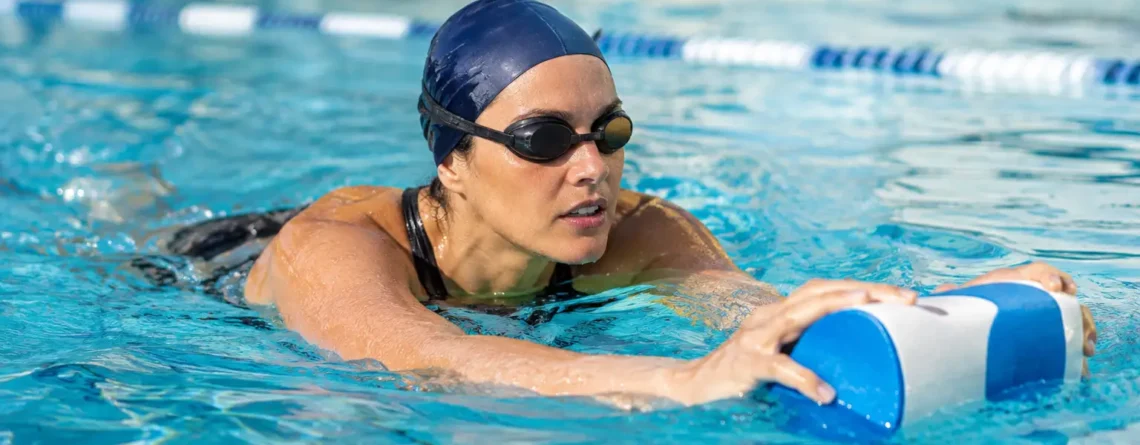
That foam figure-eight wedged between a swimmer’s thighs can look like a fairly lazy way to get through a set. It is not. So, what does a pull buoy actually do and do you need one? Used well, it is a simple tool for isolating your upper-body stroke, helping you feel a better body position and giving your legs a break. Used badly, it can let you ignore the bits of your swimming that need attention.
A pull buoy is useful training gear, not compulsory pool luggage. If you swim for fitness once a week and enjoy simply clocking laps, you can happily leave it in the swim bag. If you do regular squad sessions, want to improve your stroke awareness, or are training for a triathlon, it can earn its place quickly.
What a pull buoy actually does in the water
A pull buoy is a shaped piece of buoyant foam that sits high between your thighs. It lifts your hips and legs closer to the surface, reducing drag from sinking legs. Because it floats, you need far less kick to stay balanced. That leaves you to focus on your pull, body rotation, breathing and how your hand moves through the water.
The key word is focus. With your legs supported, you can feel whether your arm stroke is doing useful work. A smoother catch and pull often become easier to notice when you are not thinking about kicking hard just to stop your feet from dropping towards the lane rope.
It also reduces the workload on your legs. That is handy after a hard ride, before a running session, or halfway through a long swim set when your kick has gone from purposeful to decorative. Triathletes often use a pull buoy for this reason, particularly in sessions designed around swim endurance rather than kick development.
There is another practical benefit: a pull buoy can slow things down mentally. During a pull set, you have room to pay attention to one or two details, such as keeping your elbow high through the catch or finishing each stroke past your hip. That is more productive than trying to fix six things while getting a face full of chlorinated water.
Why it can make swimming feel easier
Most adult swimmers naturally carry more weight in their hips and legs than in their chest. Your lungs provide a handy flotation device at the front of your body, but your lower half may sit lower. A pull buoy counteracts that balance and makes a flatter position easier to hold.
That can make you feel faster, and sometimes you will be faster over the same effort. But the buoy has not magically improved your whole stroke. It has removed some drag and taken kicking out of the equation. Think of it as a useful training setting, not a preview of exactly how you will swim without it.
For newer swimmers, this can be encouraging. You get a sense of what it feels like to travel through the water with hips nearer the surface. The trick is to carry that feeling into normal freestyle by improving your balance, head position and kick, rather than assuming the buoy is the answer to every wobbly length.
What a pull buoy does not do
A pull buoy does not teach you to kick. It does not fix a dropped elbow, crossed-over hand entry or rushed breathing. And it does not replace swimming without equipment.
In fact, too much pull-buoy swimming can hide a weak kick or poor body balance. If your legs sink the moment you remove it, that is useful information. It may mean you need more time on basic balance drills, relaxed kicking and keeping your head still as you breathe.
Be careful not to clamp down with your knees either. Hold the buoy gently between the upper thighs and let your legs stay long and relaxed. Squeezing it for dear life can make your hips stiff and interfere with natural body rotation. If it repeatedly shoots off towards the person in the next lane, move it slightly higher or choose a size that suits you better.
Who should use a pull buoy?
Regular lap swimmers can use one to break up longer sessions and give the legs a rest. A few short pull intervals are also a good way to practise holding form when your arms start tiring.
Triathletes will usually get plenty of value from one. Your legs have plenty to do on the bike and run, and many triathlon swim sessions include pull work to build upper-body endurance. Still, do not turn every pool session into a pull set. In open water, you will still need to kick lightly for balance, direction changes, starts and getting around other swimmers without causing a small aquatic incident.
Developing swimmers can benefit too, provided the buoy is used as a learning aid rather than a flotation crutch. Start with short repeats and notice what changes in your position. Then take it out and try to keep your hips high through a relaxed, steady kick.
If you are a confident swimmer who already has a well-balanced stroke, a pull buoy remains useful for targeted strength-endurance work. It is not only beginner gear. Plenty of experienced swimmers use one because simple tools still do simple jobs well.
When you probably do not need one
You can skip a pull buoy if you are just starting swimming lessons and are still becoming comfortable in the water. A coach or instructor will usually have more suitable tools and drills for that stage.
You can also skip it if your sessions are short and you would rather spend your limited pool time swimming normally. There is no prize for owning every bit of kit hanging beside the pool. Goggles that do not leak and a cap that stays put may be the more useful purchases first.
If kicking is clearly your weak point, do not use a pull buoy to avoid it altogether. Include some kick work, even if it is only a few short lengths with a board or on your side. Your kick does not need to be huge, but it should help you stay balanced and connected through the water.
How to use a pull buoy without wasting the set
Start with it between the upper thighs, not down at the knees or ankles. Push off as usual, keep a light hold on the buoy and let your feet trail near the surface. You can use a very small, relaxed kick if it helps your rhythm, but the goal is to avoid powering through the water with your legs.
For a simple session, add four to eight repeats of 50 metres with easy rest between each one. Hold an effort where you can pay attention to your technique. On one repeat, focus on a long body line. On the next, focus on entering your hand cleanly and pulling back rather than down. Small targets work better than trying to rebuild your freestyle during one Tuesday-morning session.
A pull buoy pairs naturally with hand paddles, but that combination is best introduced carefully. Paddles increase the load on your arms and shoulders, so use a size you can control and keep the set short at first. If your stroke falls apart or your shoulders feel unhappy, remove the paddles and keep the buoy. More gear is not automatically more useful.
For flip turns, many swimmers simply keep a gentle hold on the buoy and let it stay in place. If that feels awkward, use open turns. The best turn is the one that does not launch your equipment down the lane.
Choosing a pull buoy
Most adult pull buoys are made from lightweight foam and will suit a wide range of swimmers. A larger buoy provides more lift, which can be helpful for bigger swimmers or those whose legs sink substantially. A smaller model may feel more natural for younger swimmers, smaller adults or anyone who finds a standard buoy pushes their hips too high.
Comfort matters more than fancy shaping. You want one that stays put without forcing you to grip tightly, feels comfortable against your legs and survives regular trips through a wet swim bag. Foam can pick up dents and marks over time, especially when it is stuffed under wet towels and goggles, but that does not usually affect how it works.
A pull buoy is worth having when it gives purpose to part of your training, not because everyone else at squad has one. Try a few focused lengths, then take it away and see what carries over into your normal swimming. That is where the useful lessons are.